


Have you ever looked in the mirror and wished one crooked tooth could look straighter without committing to traditional braces? You may have more options than you think.
If you’re wondering how to fix a crooked tooth without braces, the right solution depends on how crooked the tooth is and whether you need to move it or simply change its appearance.
can gradually move mild to moderate misalignment, while options like dental bonding and veneers can create a straighter-looking smile without moving the tooth.
In this guide, you’ll learn which options may work for your situation, how long they take, and how to choose the right dentist for your smile goals.
Key Takeaways
- You can often treat a snaggletooth or crooked smile without full braces if your case is mild to moderate.
- Clear aligners and cosmetic dentistry options like veneers or each offer different benefits depending on your goals.
- Understanding what caused your crooked smile helps you choose a treatment that gives you a lasting, straight result.
Table of Content
- When Can You Fix a Crooked Tooth Without Braces?
- Clear Aligners for Fixing a Snaggletooth
- Cosmetic Options That Create a Straighter-Looking Smile
- What Causes a Crooked Smile and Why It Matters
- Choosing the Right Treatment for a Crooked Tooth
- Frequently Asked Questions
When Can You Fix a Crooked Tooth Without Braces?
You can often skip full braces if your crooked tooth is a small cosmetic issue rather than a deep structural problem.
Knowing the difference helps you pick a treatment that actually fixes your smile instead of just covering it up.
Minor Cosmetic Misalignment vs. True Tooth Movement
Some crooked teeth are just about looks. Others involve real shifts in your jaw or bite.
Cosmetic fixes like veneers or dental bonding can cover a snaggletooth without changing its position.
True tooth movement is different. It means the tooth actually needs to shift inside the bone. Clear aligners can handle this in mild cases, but they have limits.
Most at-home aligners can rotate a tooth up to 15 degrees, while in-office aligners can manage 20 to 30 degrees.
Not sure which option is right for you? Learn whether dental bonding can replace veneers for your smile.
Signs a Crooked Tooth May Affect Your Bite
A crooked tooth isn’t always harmless. Sometimes it changes how your teeth meet when you bite down.
Watch for these signs:
- Your teeth don’t line up evenly when your mouth is closed
- You notice uneven wear on one or more teeth
- You have jaw pain or clicking sounds
- Chewing feels harder on one side than the other
- You grind or clench your teeth without meaning to
These signs point to bite problems or a misaligned bite, not just a cosmetic issue. A snaggletooth can throw off how force spreads across your teeth, which can lead to cracks or chips over time.
If you notice any of these changes, get checked before choosing a treatment.
When Comprehensive Orthodontic Care Is Needed
Not every crooked smile can skip full orthodontic treatment. Some problems go deeper than one tooth.
If you have severe crowding, a noticeable overbite, or jaw alignment issues, you likely need more than cosmetic fixes. These problems affect multiple teeth and sometimes the jaw itself.
Traditional braces, especially traditional metal braces, are often the best choice here because they can move teeth in ways aligners and veneers cannot.
Comprehensive orthodontic treatment also matters when bite problems affect chewing, speech, or jaw comfort. Skipping it in these cases can make things worse over time.
Talking with an orthodontist can help you figure out if your case truly needs full treatment.
Clear Aligners for Fixing a Snaggletooth
Clear aligners are a popular way to fix a snaggletooth without wearing metal braces. They work well for many people, but not everyone is a good fit for this treatment.
How Removable Aligners Straighten Teeth
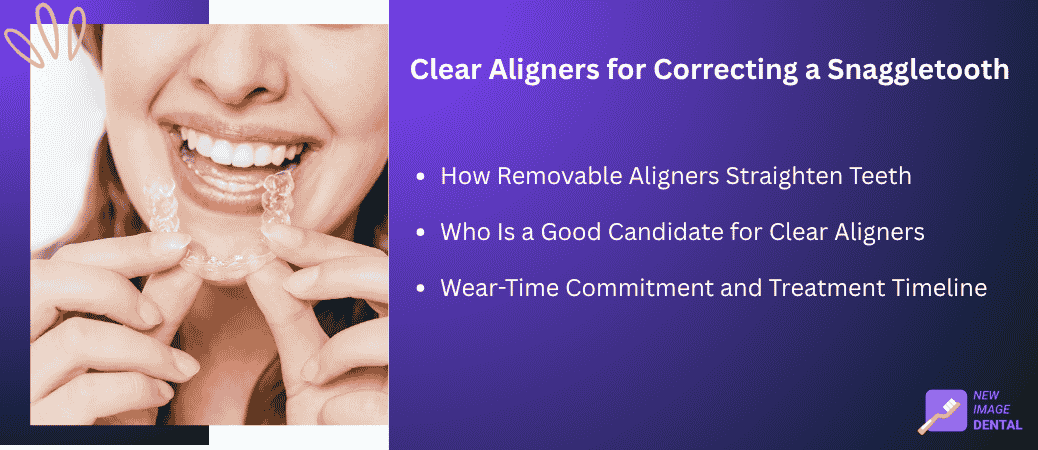
Clear aligners are thin, plastic trays that fit over your teeth. You wear a new set every one to two weeks, and each tray shifts your crooked teeth a tiny bit.
Your dental provider designs a full treatment plan before you start. This plan maps out how your teeth will move over time.
Some cases need small bumps called attachments. These are tooth-colored and glued onto certain teeth.
Attachments give the aligner tray better grip. This helps it turn or lift a snaggletooth into place, especially when rotation is involved.
Who Is a Good Candidate for Clear Aligners?
Not every snaggletooth case works well with clear aligners. Your orthodontist will look at three things: the tooth’s shape, how much it’s rotated, and its height compared to other teeth.
Mild to moderate cases tend to do best. If a tooth is rotated more than 20 degrees, standard aligners may not have enough grip to move it.
Some brands, like Clarity aligners, can handle rotations up to 30 degrees. Aligners also cannot raise or lower a tooth in the gum line.
If your snaggletooth needs that kind of movement, your dental provider may suggest braces instead. A quick exam can tell you which option fits your smile.
Aligner Wear Time and Treatment Timeline
Clear aligners only work if you wear them enough. Most providers recommend keeping them in for 20 to 22 hours a day.
You take them out to eat, drink, and brush your teeth. Skipping wear time can slow down your results or stop your teeth from moving as planned.
Treatment length depends on how crowded your teeth are. Many mild cases finish in about six months, while more involved cases can take longer.
Cases that involve moving back teeth often take 12 to 18 months. Sticking to your wear schedule is one of the best ways to protect your oral health and reach a straighter smile on time.
Cosmetic Options That Create a Straighter-Looking Smile
If your teeth are only a little crooked, you don’t always need to move them to get a straighter smile.
A cosmetic dentist can change the way your teeth look on the outside, which can make small gaps, twists, or uneven edges much less noticeable.
Porcelain Veneers for Visible Front Teeth
Veneers are thin shells that cover the front of your teeth. They’re a popular choice if you have a snaggletooth or a tooth that sits slightly out of line with the others.
Porcelain veneers are custom-made to match the color and shape of your other teeth. Your dentist will remove a small layer of enamel first, then bond the veneer in place.
This creates a smooth, even look across your smile.
Veneers work best when your bite is healthy and your misalignment is mild. If you have a more serious bite problem, veneers alone may not be strong enough to fix it.
Dental Bonding for Small Shape Corrections
Dental bonding uses tooth-colored resin to reshape a tooth. Your dentist applies the resin directly to your tooth, then shapes and hardens it with a special light.
It works well for small fixes, like a chipped edge or a tooth that looks slightly rotated.
It’s also one of the more affordable cosmetic dental procedures since it doesn’t require lab work like veneers do.
Bonding usually takes just one visit. The resin can last several years, though it may need touch-ups over time since it’s softer than porcelain.
Tooth Contouring for Slightly Uneven Edges
Tooth contouring is a simple way to smooth out small differences in tooth length or shape.
Your dentist gently files down tiny amounts of enamel to even out the edges of your teeth.
This method works best for very minor issues, like one tooth that sticks out slightly more than the others.
It won’t fix real crowding or major gaps, but it can help your smile look more balanced.
Contouring is quick, painless, and doesn’t require any recovery time. Many people combine it with bonding or whitening for a straighter smile in just one appointment.
What Causes a Crooked Smile and Why It Matters
A crooked smile can come from your genes, your habits, or even a missing tooth. Knowing the cause helps you and your dentist pick the right fix and avoid bigger problems later.
Genetics, Jaw Size, and Tooth Crowding
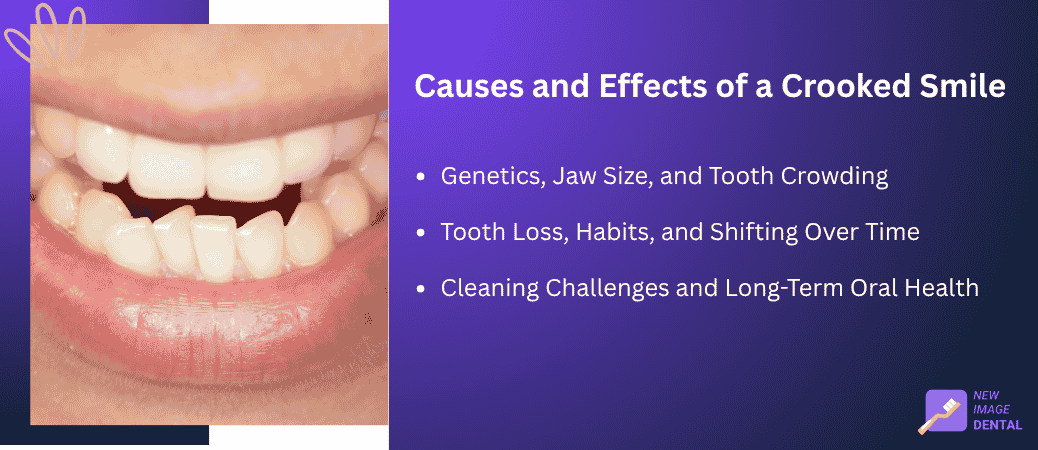
Your smile shape often comes from your parents. If you inherit a small jaw from one side of your family and large teeth from the other, your teeth may not have enough room.
This leads to crowding, rotation, or other irregularities even when your bite lines up normally.
Severe crowding happens when there just isn’t enough space in your jaw. Your teeth may end up twisted, overlapping, or pushed out of line.
This can affect your top teeth, your bottom teeth, or both.
Genetics also play a role in jaw alignment. Your jaw might grow too far forward, too far back, or not line up evenly with your other jaw.
This can cause your bite to feel off, even if each tooth looks fine on its own.
Tooth Loss, Habits, and Tooth Shifting
Your teeth are not fixed in place forever. If you lose a tooth, the teeth around it can drift into the empty space. This shift can pull your whole smile out of line over time.
Certain habits also cause problems. Thumb sucking, pacifier use past age four, and tongue thrusting can push teeth in the wrong direction.
Kids who suck their thumb for a long time often end up with teeth that grow crooked.
Your smile can also change simply because you get older. Teeth naturally shift and crowd over the years, much like skin wrinkles or hair turns gray.
If you had straight teeth as a teen, you might notice new crowding decades later.
Cleaning Challenges and Long-Term Oral Health
Crooked teeth are harder to clean than straight ones. Food and plaque get stuck in tight spots between overlapping or twisted teeth.
Over time, this raises your risk of cavities and gum disease.
Your bite matters too. If your teeth don’t come together the right way, you may put extra pressure on certain spots.
This can wear down your enamel faster or strain your jaw muscles.
Left untreated, these problems can grow worse. What starts as a small alignment issue can turn into bigger oral health concerns, including tooth damage or chronic jaw pain.
Addressing a crooked smile early can help you avoid these issues down the road.
Choosing the Right Treatment for a Crooked Tooth
Picking the right fix depends on your budget, timeline, and how long you want the results to last.
Once you choose a treatment, keeping your smile in place takes a little extra care.
How a Dental Professional Assesses Your Smile
Before you pick a fix, you need an exam from a dental provider. A cosmetic dentist or orthodontist will look at how your teeth fit together and check if your bite is off.
They will also take X-rays or scans to see the roots and bone. This helps them figure out if your tooth can move safely or if it needs a cosmetic cover instead.
Your dentist will ask about your goals too. Do you want a quick fix, or are you okay with a treatment that takes a few months? Your answer helps guide the plan they suggest.
Comparing Treatment Time, Cost, and Durability
Each option comes with its own trade-offs. Here’s a quick breakdown:
| Treatment | Time Needed | Cost Range | How Long It Lasts |
| Veneers | 2-3 visits | High | 10-15 years |
| Dental bonding | 1 visit | Low | 3-7 years |
| Clear aligners | 4-12+ months | Medium-High | Permanent, with retainer use |
Veneers give fast results but cost more upfront. Dental bonding is cheaper but wears down faster and may need touch-ups.
Clear aligners take longer since they move your teeth step by step. But once your teeth settle, the change can last for good, as long as you follow up with proper care.
Why Retainers and Follow-Up Care Protect Alignment

After any orthodontic treatment, your teeth can drift back to their old spot. This is called relapse, and it happens more often than people expect.
Retainers stop this from happening. They hold your teeth in place while your gums and bones adjust to the new position.
Most dentists recommend wearing retainers every night for at least a year. After that, a few nights a week can help keep things steady long term.
Follow-up visits also matter. Your dentist can catch small shifts early, before they turn into bigger problems that need more treatment.
Frequently Asked Questions
Here are quick answers to common questions about fixing a crooked tooth or snaggletooth without full braces, covering cost, treatment time, and how to care for your smile after treatment.
What treatment options can straighten one crooked tooth without full braces?
You have several choices if you want to fix just one tooth. Clear aligners like Invisalign can shift a single tooth into place over time.
Dental bonding and veneers are also options, though they change how the tooth looks rather than moving it.
Tooth contouring can help too, but only for very minor cases.
Your dentist can look at your tooth and tell you which option will work best for your situation.
Can clear aligners fix a snaggletooth, and how long does treatment usually take?
Yes, clear aligners can fix a snaggletooth in most mild to moderate cases. Invisalign works well for minor to moderate crookedness and often takes less time than traditional braces.
Treatment time depends on how crooked your tooth is. Many people see results in a few months, though some cases take longer.
You’ll need to wear your aligners for most of the day, every day, for them to work.
Is dental bonding a good option for making a crooked tooth look straighter?
Dental bonding can be a good choice if your tooth is only slightly crooked. This treatment uses a tooth-colored material to reshape the tooth so it looks straighter.
Bonding is quick and usually doesn’t hurt. It’s also less expensive than many other options.
Keep in mind that bonding only changes how the tooth looks. It doesn’t actually move the tooth into a new position.
Can veneers correct a crooked smile without moving the teeth?
Veneers can make your smile look straighter without moving your teeth at all. Porcelain veneers are more of a cosmetic fix than a true correction, but they can still improve how your smile looks.
A dentist places a thin shell over the front of your tooth. This covers up the crookedness and gives you a straighter-looking smile.
Veneers work best for minor issues. They aren’t a good fit if your teeth are very crowded or badly misaligned.
How much does it cost to fix a single crooked tooth without traditional braces?
Costs vary a lot depending on which treatment you choose. Bonding tends to be the cheapest option, while veneers and clear aligners cost more.
Your final price depends on how crooked your tooth is and where you live. It also depends on which dentist or orthodontist you see.
Ask your dentist for a cost estimate before you start treatment. Many offices offer payment plans to help spread out the cost.
Will I need a retainer after correcting a crooked tooth?
In most cases, yes. Teeth can shift back to their old position if you don’t wear a retainer after treatment.
Some minor cases can be treated with a retainer alone if your tooth only has slight spacing or rotation issues.
Your dentist will tell you how often to wear it based on your specific case.
Skipping your retainer, even for a short time, can undo months of progress. It’s worth sticking to the schedule your dentist gives you.
Conclusion
A crooked tooth does not always mean you need traditional braces. Depending on the severity of the misalignment and your bite, you may be able to improve your smile with clear aligners, dental bonding, veneers, or tooth contouring.
The key is choosing a treatment that addresses your specific needs rather than simply covering up the problem.
If you’re still wondering how to fix a crooked tooth without braces, a dental evaluation can help you understand which options are realistic for your smile.
With the right treatment and proper follow-up care, you can achieve a straighter-looking smile while protecting your long-term oral health.