


If you smoke and are considering dental implants, you may wonder how much it could affect your recovery.
The connection between smoking and dental implant healing matters because your body needs healthy blood flow, oxygen, and bone activity to secure the implant.
Smoking can interfere with these processes and increase the risk of complications during healing. That does not mean an implant will automatically fail if you smoke.
Many smokers still have successful dental implants, but reducing or stopping tobacco use can improve the conditions your mouth needs to heal.
Knowing when smoking poses the greatest risk, what happens during osseointegration, and what you can do before and after surgery can help you protect your implant and make informed decisions about your care.
Key Takeaways
- Nicotine and smoke starve healing bones of blood and oxygen, which slows the bond between bone and implant.
- The first days and the following three to six months carry the most risk, and later bone loss is a separate, ongoing threat.
- Honest talk with your implant team and the longest smoke-free stretch you can manage give you the best odds.
What Does Smoking Do to a Healing Implant?
Smoking works against implant healing in three ways: it squeezes blood vessels, it slows the bone cells that grip the implant, and it puts the fragile blood clot at risk.
Each effect is small on its own, but together they make bone bonding slower and less certain.
How Do Nicotine and Smoke Affect Blood Flow and Oxygen?
Nicotine makes small blood vessels tighten. Your gums and jawbone depend on those tiny vessels to bring oxygen, nutrients, and immune cells to the surgical site.
When they narrow, healing tissue gets less of everything it needs.
Cigarette smoke adds a second problem: carbon monoxide. It grabs onto your red blood cells in place of oxygen, so the blood that does arrive carries less of it.
Researchers also point to thicker, stickier blood and weaker white blood cells in smokers, as described in a PubMed Central review of smoking and dental implants.
For you, that means a weaker immune response right when bacteria in your mouth are trying to reach a fresh wound.
How Does Smoking Interfere with Osteoblasts and Bone Bonding?
Osteoblasts are the cells that lay down new bone. During osseointegration, they build bone right up against the implant surface until the post is locked in place, the way a fence post sets in concrete.
Low oxygen slows these cells down. Smoking also raises inflammatory signals that tell other cells to break bone down.
So you end up with less bone being built and more being cleared away, a poor trade during the weeks your implant needs bone growth most.
Lab and gene studies support this picture. One clinical team compared gene activity in fluid around implants in smokers and nonsmokers during early healing and found the two groups respond differently.
Why Is the Surgical Clot Vulnerable After Implant Placement?
The blood clot that forms after surgery is the starting scaffold for new tissue. It seals the wound and gives healing cells a place to gather.
Smoking threatens that clot in two ways. The sucking motion of drawing on a cigarette creates suction in your mouth, and hot smoke irritates the stitched gum.
Smokers are well known for dry socket after extractions, and the same delicate early healing happens around a new implant.
If you had a tooth pulled at the same visit, that socket is at extra risk. Follow your after dental surgery care instructions closely during the first week.
When Does Smoking Matter Most?
Timing changes the risk a lot. The weeks before surgery set up your blood supply, the first days protect the clot, and the next three to six months decide whether bone fully bonds to the implant.

How Long Should You Quit Before Implant Surgery?
Any smoke-free time before surgery helps. Blood vessels start to recover within days of stopping, and carbon monoxide clears from your blood fast.
Many implant teams ask for at least one to two weeks without tobacco before placement, and some prefer four to eight weeks when possible.
Your surgeon will set the exact plan based on your health, how much you smoke, and the work being done.
In practice, patients who start cutting back the moment they book surgery have an easier time. Quitting cold the night before is much harder than tapering over a few weeks.
Ask your doctor about nicotine replacement or quit-smoking medicine, and let your implant team know which you choose.
What Happens If You Smoke in the First Days After Surgery?
The first 72 hours are when your clot is newest and your gum is most tender. Smoking now raises your chance of slower wound closure, more pain, and infection.
If you already smoked, here is what to do:
- Stop for the rest of healing if you can. Each smoke-free day helps.
- Rinse gently as your dentist told you. Do not swish hard or spit forcefully.
- Watch for warning signs: pain that gets worse after day three, a bad taste, swelling that grows, or pus.
- Call your implant office and tell them. They would much rather hear it now.
One slip does not mean failure. Your body heals in a pattern, and the overall exposure across healing counts more than a single moment.
Why Do the Next 3–6 Months Still Matter?
Bone bonding is slow. Once the gum closes, the real work happens underneath over roughly three to six months, as new bone replaces the first soft tissue around the implant.
Smoking during this stretch keeps lowering oxygen to the bone. Some research suggests the biggest problems show up once the implant is uncovered and the gum around it is exposed to smoke, which is why the period after second-stage surgery deserves the same care.
A recent systematic review of tobacco and smoke-free products found the early-failure data too limited to confirm smoking directly blocks osseointegration.On the other hand, The Oral Health reported from a study, where 478 smokers and 1,207 non-smokers, smokers lost about a sixth of a millimeter more bone around their dental implants each year than non-smokers.
That is honest science, and it should not be read as permission. The same review and many others link smoking to worse long-term results.
Does Vaping Change the Healing Risk?
Vaping removes the smoke and carbon monoxide, but most vapes still deliver nicotine. Nicotine is the part that tightens blood vessels, so vaping is not a safe swap during healing.
The research on vaping and implants is still young, and there is not enough long-term data to call it low risk. The puffing motion also creates suction on a fresh wound.
If you need nicotine to get through healing, ask your doctor about a patch, which avoids both smoke and suction.
How Much Does Smoking Change Implant Outcomes?
Smoking roughly doubles the chance of losing an implant in many studies, yet most smokers’ implants still succeed. The key is reading “higher odds” correctly and knowing that risk shows up at different stages.
What Do Studies Show About Failure in Smokers vs. Nonsmokers?
A 2021 systematic review and meta-analysis pooled clinical studies and found that smokers had a significantly higher risk of implant failure than nonsmokers.
Older studies report implant failure rates in smokers ranging from 6.5% to 20%, in the review linked earlier.
How much you smoke counts too. A narrative review of smoking and implant therapy notes the relative risk of failure is significantly higher in people who smoke 20 or more cigarettes a day.
Here is how to read those numbers:
| What studies report | What it means for you |
| “Odds” or “relative risk” doubles | Your risk compared with a nonsmoker is higher |
| Failure rate of 6.5% to 20% in smokers | Most implants in smokers still survive |
| Heavier smoking, higher risk | Cutting back still helps if you cannot quit |
Odds describe groups. Your own chance depends on your bone, gum health, implant site, and habits.
Upper jaw implants fail more often in smokers than lower ones, likely because the upper bone is softer. Implant brands play a much smaller role than these patient factors.
Can an Implant Succeed Initially but Lose Bone Later?
Yes. An implant can bond well, get its crown, and still lose bone years later. This is called marginal bone loss, and when infection drives it, it becomes peri-implantitis, the implant version of gum disease.
A clinical study of heavy smokers followed for 15 months tracked 29 patients who smoked more than 20 cigarettes a day for at least five years, measuring bone loss, stability, and success against nonsmokers.
Smoking also hides warning signs. Narrow blood vessels mean your gums bleed less, even when infection is present. That is why regular checkups and strong dental implant care and maintenance habits are your best defense.
Does Smoking Affect Primary and Secondary Stability Differently?
Primary stability is how tight the implant fits the day it goes in. It comes from the shape of the implant and the density of your bone. Secondary stability is the stronger hold that forms later as new bone grows onto the surface.
Smoking has little effect on that first mechanical fit. Its impact falls on secondary stability, the biological part. An implant-stability study looked at how stability develops in smokers compared with nonsmokers during healing.
This is why an implant can feel solid at surgery and still struggle weeks later. Your dentist may measure stability before attaching a tooth, and smokers sometimes get a longer wait before loading.
How Can Smokers Protect Their Implant Investment?
Your best protection is honesty plus a plan built around your habits. Your team can adjust timing, grafting, and follow-up when they know the full picture.
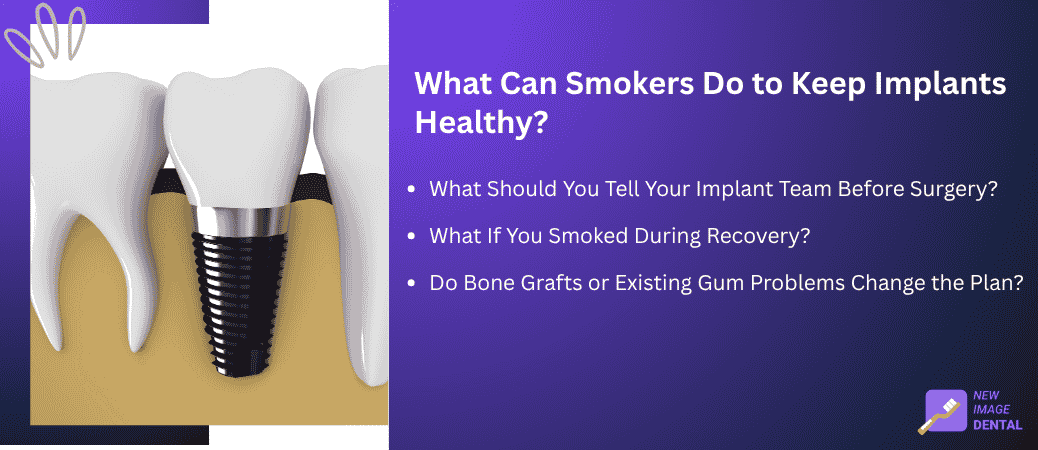
What Should You Tell Your Implant Team Before Surgery?
Share the real numbers. Your team needs to know:
- How many cigarettes, vapes, or cigars you use per day
- How long you have smoked
- Whether you have tried to quit and what helped
- Any cannabis or chewing tobacco use
At New Image Dental, these answers shape your plan. Smokers may get a longer healing period, extra check-ins, or added infection steps.
You can read about dental implant candidacy and what the dental implant surgery process looks like so you know what to ask.
Nobody here will lecture you. Accurate information lets your team protect your result.
What If You Smoked During Recovery?
Tell your dentist at your next visit or call sooner if anything feels off. Stop again as soon as you can, since each smoke-free day helps the bone.
Keep the area clean with gentle brushing and any prescribed rinse. Show up for every follow-up, even if you feel fine. Early problems are easier to treat, and many smokers who slipped still heal well.
Do Bone Grafts or Existing Gum Problems Change the Plan?
Yes. Grafts need a good blood supply to turn into living bone, so smoking raises their risk. Smoking is linked to more wound opening and infection after sinus lift surgery, per the narrative review cited earlier.
If you need a bone graft for dental implants, a longer smoke-free window makes a real difference.
Gum disease adds risk too. Smokers have higher rates of periodontal disease, and that history raises the odds of peri-implantitis. Your dentist may treat your gums first, sometimes with periodontal laser therapy, before placing implants.
Give the Bone Its Best Chance to Heal
Smoking tightens blood vessels, lowers oxygen, and slows the cells that build bone around an implant. The risk is highest in the first days and the three to six months of osseointegration, and smokers also face more bone loss and infection years later.
Odds are not destiny. Most dental implants in smokers succeed, especially when patients cut back, plan ahead, and keep up with checkups.
If you are planning surgery or worried about a cigarette during recovery, reach out to New Image Dental. Share your smoking habits openly, ask how long your healing window should be, and book your follow-up visits before you leave the office.
Frequently Asked Questions
Will one cigarette after implant surgery make the implant fail?
No, one cigarette is very unlikely to cause failure by itself. It does add stress to the clot and blood supply, so stop again right away and tell your dentist. Watch for worsening pain, swelling, or a bad taste.
How long should I stop smoking before dental implant surgery?
Many implant teams ask for at least one to two weeks smoke-free, and four to eight weeks is better when possible. Longer helps blood flow recover more fully. Your surgeon will set your exact timeline.
When can I smoke after dental implant placement?
There is no single safe date, and your surgeon should guide you. The first days are highest risk, and smoking keeps slowing bone bonding through the three to six month healing window. The longer you wait, the better your odds.
Is light smoking safer while an implant heals?
Light smoking carries less risk than heavy smoking, since studies show risk climbs with cigarettes per day. It still lowers oxygen and blood flow to the bone. Cutting back helps, but stopping during healing helps more.
Can I vape instead of smoking after dental implant surgery?
Vaping is not a safe substitute because most vapes still contain nicotine, which narrows blood vessels. The puffing also creates suction on the wound. Ask your doctor about a nicotine patch if you need help.
Can smoking cause an implant to fail after it has healed?
Yes, smoking raises the risk of later bone loss and peri-implantitis around a healed implant. It can also hide early signs like bleeding gums. Regular cleanings and checkups help catch problems early.