


You brushed your teeth twenty minutes ago and still the bad breath won’t go away? If that sounds familiar, you know how discouraging persistent bad breath can feel, especially when mints, mouthwash, and gum only cover it up for a few minutes at a time.
Bad breath that fades after a meal or a cup of coffee is normal.
Bad breath that keeps coming back no matter what you do is usually a sign that something in your mouth, and sometimes elsewhere in your body, needs attention.
This kind of odor has a real, findable cause, whether it’s bacteria hiding under your gumline, a cavity you can’t see, or dry mouth from a medication you take every day.
You’re not alone in dealing with this, and it isn’t a hygiene failure on your part. Chronic halitosis is a recognized dental and medical issue with clear diagnostic paths and real treatment options.
Key Takeaways
- Odor that returns quickly after brushing often points to bacteria trapped below the gumline, on the tongue, or around teeth that home care can’t reach.
- Signs like bleeding gums, tooth pain, or a dry mouth can help narrow down whether the cause is gum disease, decay, or something else.
- A dental check-up can identify or rule out oral causes, while a medical evaluation may be needed if the mouth checks out clear.
When Is Bad Breath More Than a Diet Issue?
Bad breath crosses from “normal” to “worth checking” when it lingers for weeks despite good oral hygiene. Foods like garlic and onions, along with coffee, alcohol, and sugary snacks, cause short-term odor that clears up on its own.
When the smell keeps returning, or shows up alongside a bad taste that won’t lift, poor oral hygiene, smoking, or tobacco products may be feeding the problem in ways diet changes can’t fix.
Temporary Odor From Garlic, Onions, Coffee, and Alcohol
Certain foods and drinks release compounds that travel through your bloodstream to your lungs, which is why brushing doesn’t always help right away. This type of odor typically clears within a few hours as your body processes the food.
Why Odor That Returns After Brushing Needs Attention
If your breath smells bad again within an hour or two of brushing, the odor is likely coming from an ongoing source your toothbrush can’t reach.
This pattern is one of the clearest signals that mouthwash alone won’t fix the underlying cause, and it’s a good reason to look closer at your gums, tongue, and teeth.
Signs That Help Identify the Source
Pay attention to what comes with the smell. A few clues worth tracking:
- Bleeding or swollen gums often points toward gum disease.
- A thick, white or yellow coating on your tongue suggests bacterial buildup there.
- A dry, sticky feeling in your mouth may mean reduced saliva.
- Pain in a specific tooth could mean decay or infection.
Halitosis prevention starts with matching the sign to the likely cause instead of guessing.
How Oral Bacteria Create Persistent Odor
Odor-causing bacteria produce a rotten-egg or sulfur smell as they break down food debris, dead cells, and plaque in your mouth.
This bacterial buildup collects on your tongue, between your teeth, and along your gumline, and it thrives even more when your mouth is dry.
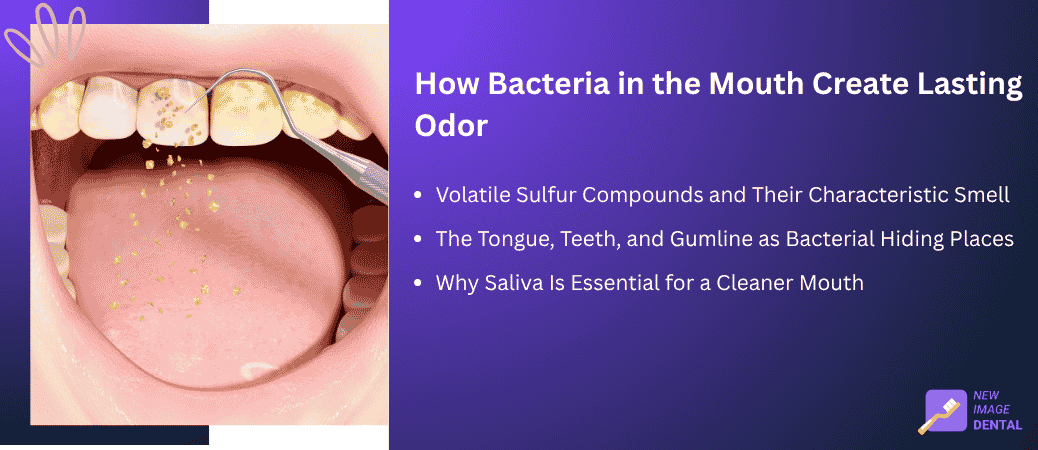
Volatile Sulfur Compounds and Their Characteristic Smell
Oral bacteria release volatile sulfur compounds, including hydrogen sulphide and methyl mercaptan, as a byproduct of digesting leftover food particles.
These compounds are what give chronic bad breath its distinct, sulfur-like smell, and they’re largely responsible for why the odor feels different from simple “food breath.”
Bacteria hidden below the gumline in deep periodontal pockets are especially efficient at producing these compounds.
The Tongue, Teeth, and Gumline as Bacterial Hiding Places
The back of your tongue is one of the biggest reservoirs for odor-causing bacteria, even in people who brush well.
Plaque buildup on teeth and tartar along the gumline give bacteria a rough surface to cling to, while food stuck between teeth adds more fuel.
A toothbrush alone often can’t reach all of these spots well enough to clear the smell for good.
Why Saliva Is Essential for a Cleaner Mouth
Saliva rinses away food debris and bacteria all day, so reduced saliva production lets odor build up faster.
Dry mouth, known clinically as xerostomia, can come from certain medications, mouth breathing, or dehydration. Drinking enough water and treating chronic dry mouth are simple habits that support fresher breath.
Dental Problems That Can Keep Breath From Improving
Gum disease, tooth decay, and dental infections are among the most common reasons bad breath won’t respond to brushing and mouthwash.
Each of these conditions creates a hidden pocket or surface where bacteria can multiply undisturbed, which is why the odor keeps returning even with a solid daily routine.

Gingivitis, Periodontitis, and Deep Gum Pockets
Gum disease starts as gingivitis, a mild inflammation causing bleeding gums and swollen gums, and can progress to periodontitis if untreated.
As periodontal disease advances, gum pockets deepen and bone loss can occur, allowing bacteria to settle in spaces a toothbrush can’t reach.
Gum recession and loose teeth are later warning signs that the infection has reached the supporting bone.
Cavities, Tooth Decay, and Dental Infections
A cavity that goes untreated can trap decaying food and bacteria inside the tooth, producing a strong, persistent odor.
Tooth pain, sensitivity to hot or cold, or visible dark spots on a tooth are signs of tooth decay worth having checked.
Left alone, decay can progress into a dental infection that may eventually need root canal treatment.
Food Trapped Around Teeth, Crowns, and Bridges
Crowns and bridges create small gaps where food can get stuck and rot if it isn’t cleaned out daily.
This is a common, often overlooked cause of ongoing odor in people who otherwise have healthy teeth.
Interdental brushes or floss threaders designed for dental work can help clear these tight spaces.
Partially Erupted Wisdom Teeth and Pericoronitis
Partially erupted wisdom teeth create a flap of gum tissue that traps food and bacteria underneath, leading to a painful gum infection called pericoronitis.
This condition often causes a distinct, strong odor along with swelling and jaw discomfort. A dentist can assess whether the wisdom tooth needs to be removed or simply monitored.
What to Do at Home and When to Book an Appointment
Good oral hygiene habits solve many cases of bad breath, but they need to target the actual sources of odor, not just mask the smell.
Fluoride toothpaste, flossing, tongue cleaning, and antibacterial mouthwash each play a different role, and knowing when home care isn’t enough helps you decide when to book a dental check-up.
Improve Daily Oral Hygiene Without Masking the Cause
Brush with fluoride toothpaste twice a day and floss once daily to remove plaque before it hardens into tartar.
Sugar-free gum with xylitol can boost saliva flow between brushings, which helps rinse away odor-causing bacteria.
Skip mouthwashes that only mask smell with strong scents; look for an antibacterial mouthwash instead, since it targets the bacteria directly.
How Tongue Cleaning and Interdental Cleaning Help
A tongue scraper removes the bacterial coating that regular brushing misses, and it takes less than 30 seconds a day.
Interdental brushes clean between teeth and around crowns or bridges more thoroughly than floss in many cases.
Doing both daily addresses two of the biggest bacterial hiding spots in your mouth.
What a Dental Examination and Professional Cleaning Can Treat
A dental examination can catch gum disease, cavities, and other issues before they cause lasting damage.
Professional cleaning, including scaling and polishing or a deeper scaling and root planing, removes tartar and bacteria that brushing at home can’t touch.
At New Image Dental, Dr. Adams can evaluate persistent bad breath, look for oral causes, and help determine the right next step for treatment.
Regular dental check-ups can help catch these problems early, and a routine dental cleaning can make a noticeable difference in breath within days.
Book a visit if you notice:
- Bad breath lasting more than two to three weeks despite good hygiene
- Bleeding, swollen, or receding gums
- Tooth pain or visible decay
- Persistent bad taste in your mouth
- Swelling near a wisdom tooth
When a Medical Evaluation Is Needed
A medical evaluation is worth pursuing if your dentist rules out oral causes and the odor persists.
Sinus infections, post-nasal drip, tonsil stones, acid reflux (GERD), diabetes, kidney disease, and liver disease can all produce breath odor that starts outside the mouth.
Treat the Source to Restore Fresher Breath

Persistent bad breath gets better once you treat what’s actually causing it, not just the smell itself.
Chronic halitosis tied to gum disease responds well to professional dental cleaning and consistent care at home, while cases pointing to a medical condition need attention from your doctor alongside your dentist.
Your oral health affects more than your breath, so addressing the root cause protects your teeth and gums for the long run too.
A dental visit gives you a clear answer instead of more guessing, and it’s a reasonable next step if home care hasn’t worked after a few weeks.
Frequently Asked Questions
Why does my mouth smell bad even after brushing?
Brushing cleans the surfaces of your teeth but doesn’t reach bacteria hiding on your tongue, between teeth, or below your gumline.
If odor returns quickly, that bacterial buildup is likely the source. A tongue scraper and interdental brushes can help close that gap.
Can gum disease cause bad breath that will not go away?
Yes, gum disease is one of the most common causes of persistent bad breath.
Bacteria trapped in gum pockets produce sulfur compounds that a toothbrush cannot reach, so the odor keeps returning until the gums are treated professionally.
How can I get rid of bad breath permanently?
There’s no single fix that works for everyone, since the right treatment depends on the cause.
Treating gum disease, fixing cavities, managing dry mouth, and keeping up daily tongue and interdental cleaning together give you the best chance at lasting fresh breath.
Can a cavity or rotting tooth cause bad breath?
Yes, a cavity traps food and bacteria inside the tooth, and as it decays, it releases a distinct, unpleasant smell.
Untreated decay can also lead to a dental infection, which often makes the odor stronger and may come with tooth pain.
I have bad breath but no dental problems. What could be causing it?
Dry mouth, sinus infections, tonsil stones, and acid reflux (GERD) are common non-dental causes of persistent bad breath.
Less often, conditions like diabetes point to an underlying issue that a doctor can help identify with a medical evaluation.
What illnesses can cause persistent bad breath?
Sinus infections, GERD, diabetes, kidney disease, and liver disease can all cause breath odor that starts outside the mouth.
These cases are less common than dental causes, so a dentist can typically help rule out oral sources first.